How to Sell Gold
HOW MUCH CAN I SELL MY GOLD FOR? A UK VALUATION GUIDE
Discover how gold purity, live market rates, and dealer fees impact your item's true worth—and learn how to estimate your payout before requesting a quote.
At a glance
HOW IS A GOLD SALE VALUE CALCULATED?
A buyer identifies the item, measures gold-bearing weight and fineness, applies a current price, then adjusts for spread, demand, condition and costs.

Written by
Richard Lyttle leads Bullion House across product standards, customer experience, and educational review. He reviews high-trust buying guidance so customers can understand physical gold, tax-sensitive product features, and resale considerations before they buy.
Reviewed by Richard Lyttle on 18 Sept 2026

On this page
How much you can sell your gold for depends on more than its weight. Gold purity, the current gold price, the type and condition of the item and the buyer's pricing all affect its value. Whether you have gold jewellery, bullion coins, bars or scrap gold, understanding these factors can help you estimate what your gold may be worth before requesting a quote.
The live gold price, your gold's weight and purity can help you calculate an estimated melt value. This gives you a useful starting point, but this doesn’t represent what a dealer will offer you. The final offer may differ because of product demand, testing, dealer spread, refining costs and other charges.
Learning how to calculate your gold's fine-gold content and understanding the difference between melt value and a real sale price will help you compare quotes before selling. When parting with high-value precious metals, it’s essential that you understand the item’s worth so you can make an informed decision.
When you're ready to find out what your gold could actually sell for, Bullion House invites you to contact us for an appointment with a view to selling your items.
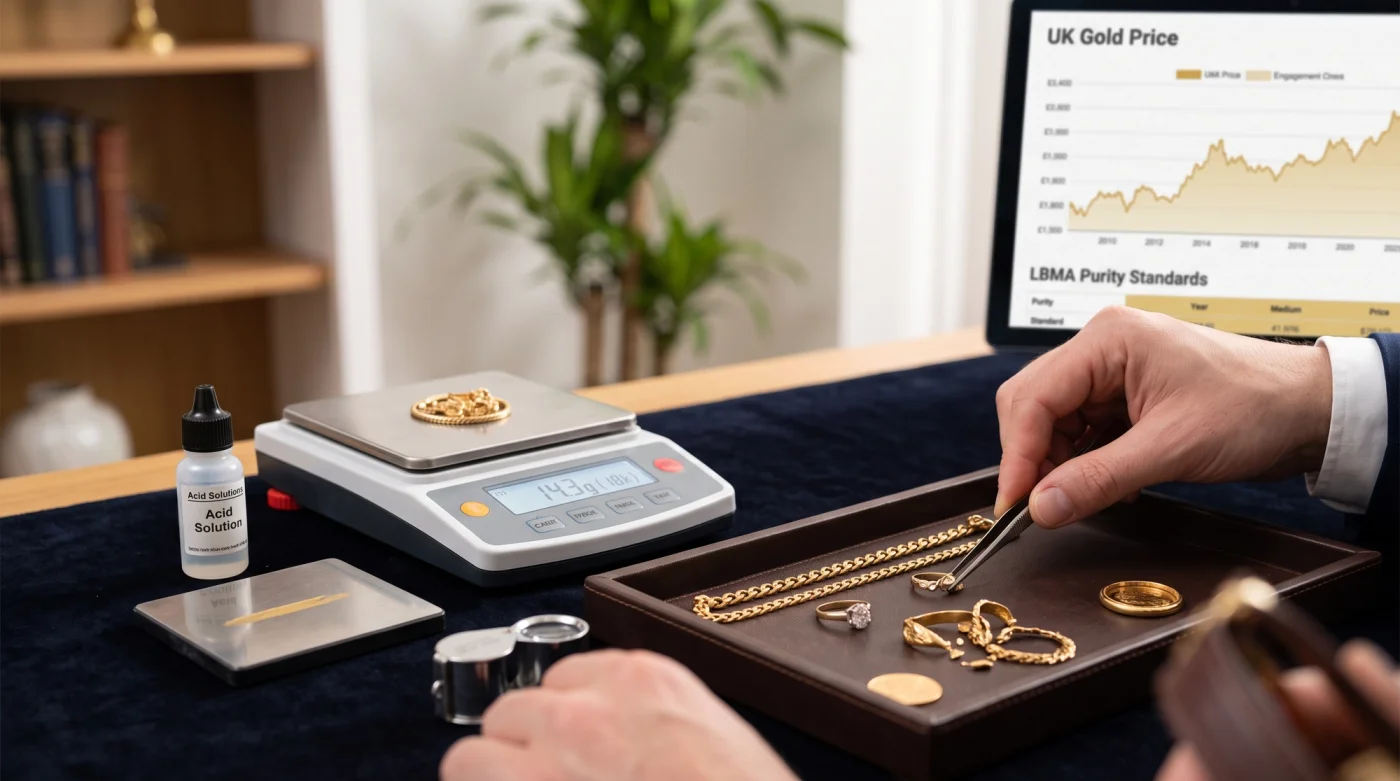
HOW DO I WORK OUT HOW MUCH MY GOLD IS WORTH?
Estimate fine-gold content, multiply it by a current reference price, then adjust for product demand, condition, non-gold weight, dealer spread and costs. Compare written net quotes before selling.
- Use fine-gold weight, not gross weight alone.
- A benchmark price is not a dealer's net buy offer.
- Collector coins and saleable jewellery need more than a scrap calculation.
WRITTEN BY
Richard Lyttle leads Bullion House across product standards, customer experience, and educational review. He reviews high-trust buying guidance so customers can understand physical gold, tax-sensitive product features, and resale considerations before they buy.
30 Jun 2026·Updated 22 Jul 2026·5 min read
Reviewed by Liam Yarwood on 22 Jul 2026
IDENTIFY THE GOLD
Before you start calculating what your gold could be worth, it helps to know exactly what you have. Separate bars, bullion coins, collector coins, jewellery, dental gold and mixed scrap before requesting a value. Each category uses different evidence and may have a different buyer market.
If you’re requesting a valuation remotely, photograph each group before handing it to a buyer or sending it for inspection. Clear photographs can help with initial identification and give you a record of the item’s condition.

- Live Price Per Gram
- e.g. £105.75
- Gold Purity
- 9 ct
- Fineness
- 375
- Weight
- 10g
- Fine-gold content
- 3.75
- Estimated Metal Value
- £396.56
- Live Price Per Gram
- Gold Purity
- 14 ct
- Fineness
- 585
- Weight
- 10g
- Fine-gold content
- 5.85
- Estimated Metal Value
- £618.64
- Live Price Per Gram
- Gold Purity
- 18 ct
- Fineness
- 750
- Weight
- 10g
- Fine-gold content
- 7.5
- Estimated Metal Value
- £793.13
- Live Price Per Gram
- Gold Purity
- 22 ct
- Fineness
- 916.7
- Weight
- 10g
- Fine-gold content
- 9.17
- Estimated Metal Value
- £969.73
- Live Price Per Gram
- Gold Purity
- 24 ct
- Fineness
- 999.9
- Weight
- 10g
- Fine-gold content
- 10g
- Estimated Metal Value
- £1057.50
| Live Price Per Gram | Gold Purity | Fineness | Weight | Fine-gold content | Estimated Metal Value |
|---|---|---|---|---|---|
| e.g. £105.75 | 9 ct | 375 | 10g | 3.75 | £396.56 |
| 14 ct | 585 | 10g | 5.85 | £618.64 | |
| 18 ct | 750 | 10g | 7.5 | £793.13 | |
| 22 ct | 916.7 | 10g | 9.17 | £969.73 | |
| 24 ct | 999.9 | 10g | 10g | £1057.50 |
USING THE GOLD PRICE
To estimate how much you can sell your gold for, you also need a current gold price to value the item’s fine-gold content. The LBMA (London Bullion Market Association) Gold Price is a wholesale benchmark stated per fine troy ounce, with published currency conversions. Retail dealers can use live spot feeds or their own hedging reference rather than the delayed public benchmark.
A reference price is not the same as a retail buy offer because it doesn’t account for factors such as testing, handling, hedging and dealer margin. Multiply fine-gold weight by the reference price per matching unit to estimate gross metal value.
This is where melt value comes in. Melt value is a calculation, not a promise that the item will be melted or bought at that amount. Use melt value as a common baseline when comparing buyers, not as the only valuation.
WHAT IS THE DEALER SPREAD?
The dealer spread is the difference between the price at which a dealer buys gold and the price at which it sells or hedges it. It is one reason the amount you receive when selling gold is usually below the headline market price.
The size of the spread can vary depending on the type and quantity of gold, market conditions, demand, and the costs involved in handling and reselling it. This means two buyers can offer different amounts for the same gold, even when they use the same underlying market price.
When comparing offers, look beyond the percentage of the spot price advertised. The amount you receive after the dealer's spread and any other deductions is the figure that is important.
LIVE PRICE CALCULATOR
Use our live price calculator to estimate the value of your gold:
- Live Price Per Troy Ounce
- e.g. £3280.86
- Live Price Per Gram
- £105.48
- Weight [Select oz t/grams]
- 10g
- Purity
- 999.9 [Select]
- Estimated Melt Value (£)
- £1054.80
| Live Price Per Troy Ounce | Live Price Per Gram | Weight [Select oz t/grams] | Purity | Estimated Melt Value (£) |
|---|---|---|---|---|
| e.g. £3280.86 | £105.48 | 10g | 999.9 [Select] | £1054.80 |
TURN MELT VALUE INTO A REAL QUOTE
A dealer buys below the price at which it expects to resell or hedge the gold. The difference covers market movement, testing, staff, insurance, refining, stock risk and profit.
For this reason, compare the final amount you’ll receive after deductions rather than the headline percentage offered.
VALUE COINS, BARS AND JEWELLERY
Not every piece of gold should be valued in exactly the same way. Recognised bullion coins can be priced from fine-gold content and current dealer demand. Date and condition may add little to an ordinary random-date bullion offer.
When requesting a remote quote, list coin, size, quantity, date range and condition. For recognised bars, include the weight, fineness, refiner and serial or assay details where present.
Sealed assay packaging can support identification, but it does not replace metal testing. It’s also best to leave a bar exactly as it is, rather than cleaning, filing or cutting it before professional review.
Gold Sovereigns use 22-carat alloys but contain defined fine-gold amounts for each format.
Modern Gold Britannias use 999.9 fine gold, while pre-2013 issues used 22-carat alloys with stated fine-gold content.
Provide the exact size and date because a Half-Sovereign and Full Sovereign aren’t interchangeable valuation units.
WHEN COLLECTOR VALUE MATTERS
Metal content alone doesn’t always determine how much you can sell your gold for. Proof finish, mintage, grade, holder, certificate and packaging can support collector value above the underlying metal value.
If a coin has a grading certificate, verify it with the grading service and make sure its photographs or identifying details match the holder.
If you’re unsure whether a coin has collector value, it’s worth getting a specialist opinion before a general gold buyer treats the coin as scrap or bullion. Jewellery value can also come from more than its gold content. Workmanship, brand, age, design, condition and gemstones can all contribute to its value.
A scrap dealer may quote only recoverable metal, while a jewellery specialist may value the complete object. Do not remove stones or repair a piece before learning whether that work would reduce value.
WHAT ABOUT SCRAP GOLD?
Scrap buyers group items by tested fineness and estimate recoverable precious metal. Solder, springs, steel pins, fillings and contamination can reduce the recoverable amount.
Keep each fineness group separate and request a weight record for each, showing gross weight, deductions and any returned stones or other components.
A buyer may return stones, buy them as separate decisions or deduct an estimated weight. Record the gross item, deducted components and returned parts on the receipt.
CONDITION, TESTING AND BUYER DEMAND
The condition and evidence surrounding your gold can also affect how it is valued. UK hallmarks can identify sponsor, fineness, assay office and date information, subject to the mark and period. Items below statutory weight exemptions may be unhallmarked and still contain gold.
If testing is needed, ask which method the buyer will use and whether any destructive work needs consent. Bullion value depends largely on metal content, but damage can remove a coin or bar from normal resale stock.
Marks, cleaning or holder damage can affect collector value, so photograph the item and packaging condition before transport.
Quantity can make a difference too. Larger bullion quantities can receive tighter percentage spreads because fixed work is shared across more metal. A buyer can also reduce a quote if a product is overstocked or hard to resell.
For the best comparison, request a quote for the actual quantity rather than applying a single-item rate yourself.
COMPARE NET WRITTEN OFFERS
A useful quote states item, weight, fineness, reference price or fixed price, deductions, fees and payment time. Ask whether the quote is indicative or binding and how long it remains open.
Retain emails, photographs and intake records until payment is complete. Subtract appraisal, assay, refining, auction, postage, insurance and payment fees from the headline offer.
Also, check whether return postage is charged if you reject the quote. Compare net proceeds and risk, not the largest advertised percentage. Some buyers fix the price when a booking is accepted, while others wait for receipt and inspection.
A later fixing leaves the seller exposed to gold-price movement during transit. Record the agreed timestamp, reference and net amount once the sale is confirmed.
A private sale can have tax implications depending on the asset, gain, owner and circumstances. Sterling legal-tender coins can receive different Capital Gains Tax treatment from bars, jewellery and foreign coins.
Seek current professional advice when the amount is significant, or the ownership history is unclear.
A WORKED VALUATION
List each item by category, weight unit, fineness and condition before using a price. Convert weight to fine-gold grams or ounces and multiply by one current reference price.
Compare the estimate with two or more written quotes and investigate material differences.
Read How to Sell Gold in the UK for the complete sale process.
Read Certified and Graded Coins before selling an encapsulated coin
Frequently asked questions
HOW IS A GOLD SALE VALUE CALCULATED?
A buyer identifies the item, measures gold-bearing weight and fineness, applies a current price, then adjusts for spread, demand, condition and costs.
WHAT PERCENTAGE OF SPOT SHOULD I RECEIVE?
There is no fixed percentage for every product. Compare written net quotes for the exact item, quantity, timestamp and inspection terms.
HOW DO I CALCULATE FINE-GOLD WEIGHT?
Multiply gold-bearing gross weight by fineness as a decimal. Ten grams at 750 fineness contains an estimated 7.5 grams of fine gold.
ARE GOLD COINS WORTH MORE THAN MELT VALUE?
Recognised bullion or collector coins can receive product value above raw metal. Date, finish, grade, condition and demand decide whether it exists.
Next practical step
Sources and further reading
Rules and market terms can change. Check the dated sources below and take advice on tax, regulation or personal finances where your position calls for it. For the practical side of buying or selling physical gold, speak to the Bullion House team.
View 15 sources
- LBMA precious metal prices
- LBMA precious metal benchmarks
- Government hallmarking consumer guidance
- Hallmarking Act 1973
- HMRC Capital Gains Tax overview
- HMRC Capital Gains Manual CG78305
- Taxation of Chargeable Gains Act 1992, section 21
- HMRC: Investment gold coins (VAT Notice 701/21A)
- HMRC high-value dealer guidance
- Scrap Metal Dealers Act guidance
- The Royal Mint: Britannia coin range
- PCGS certificate verification
- NGC certification verification
- Government company information service
- Bullion House - Sell gold