How to Buy Gold
Gold Price Per Gram in the UK: How It Works and How to Calculate It
Learn how the UK gold price per gram works, how to convert troy ounces to grams, and how purity and premiums impact your final buying or selling valuation.
At a glance
WHAT IS THE GOLD PRICE PER GRAM IN THE UK?
The gold price per gram is the current market reference value for one gram of fine gold. It can be calculated by dividing the gold price per troy ounce by 31.1035.

Written by
Richard Lyttle leads Bullion House across product standards, customer experience, and educational review. He reviews high-trust buying guidance so customers can understand physical gold, tax-sensitive product features, and resale considerations before they buy.
Reviewed by Richard Lyttle on 18 Sept 2026

On this page
The gold price per gram in the UK gives you a simple way to understand the value of gold by weight. But the figure you see is not a one-size-fits-all price attached to all types of gold products. The price you will pay for a gold bar or the amount you will receive when selling jewellery or bullion depends on more than the live gold price.
Gold is commonly quoted by the troy ounce on the international market, while physical gold products in the UK are often sold by the gram. Understanding how these measurements relate to each other, and how purity and product premiums affect the final price, can help you compare gold products and valuations more accurately.
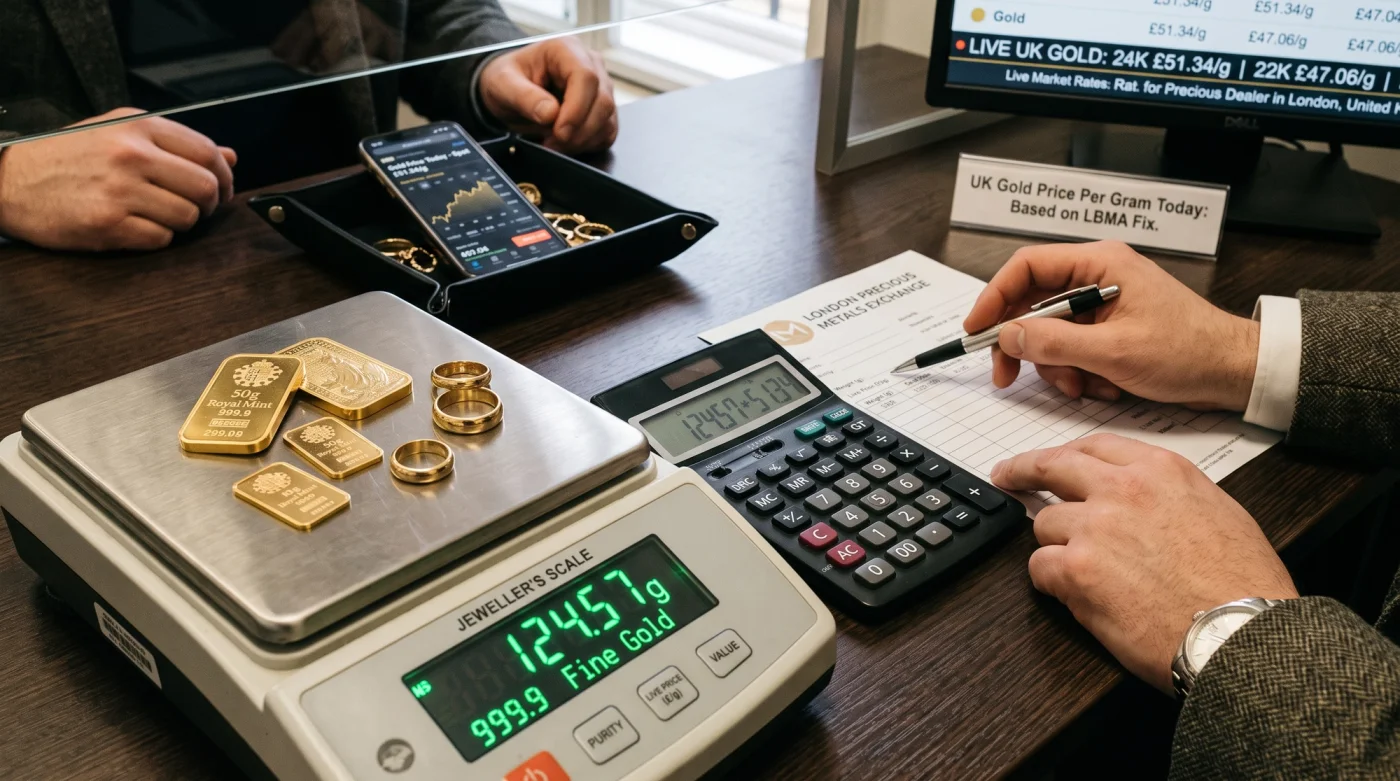
WHAT IS THE GOLD PRICE PER GRAM IN THE UK?
The gold price per gram is the value of one gram of fine gold based on a current gold-market reference price. Gold is traditionally quoted in troy ounces rather than ordinary ounces. One troy ounce of gold equals 31.1035 grams, according to HMRC.
To convert a gold price quoted per troy ounce into a price per gram, use the following formula:
Gold price per gram = gold price per troy ounce ÷ 31.1035
For example, if a reference gold price were £3,000 per troy ounce:
£3,000 ÷ 31.1035 = approximately £96.45 per gram
This is an illustration only. The live gold price changes, so the current gold price per gram should always be checked at the time you are buying, selling or valuing gold. Remember that a market reference price is not the same as a retail purchase price or a dealer's buyback offer. The final price can reflect premiums, spreads, testing, handling and other costs.
WHY IS GOLD PRICED BY THE TROY OUNCE?
A troy ounce is the traditional unit used for precious metals. It is slightly heavier than the ordinary ounce used for everyday goods. One troy ounce contains 31.1035 grams, so it is important not to use 28.35g, which is the approximate weight of a standard avoirdupois ounce. HMRC specifically gives 31.1035g as the conversion for a gold ounce.
When comparing prices, make sure you’re comparing like with like. A price per troy ounce, price per gram and price per kilogram can all describe the same underlying gold price once the correct conversion has been made.
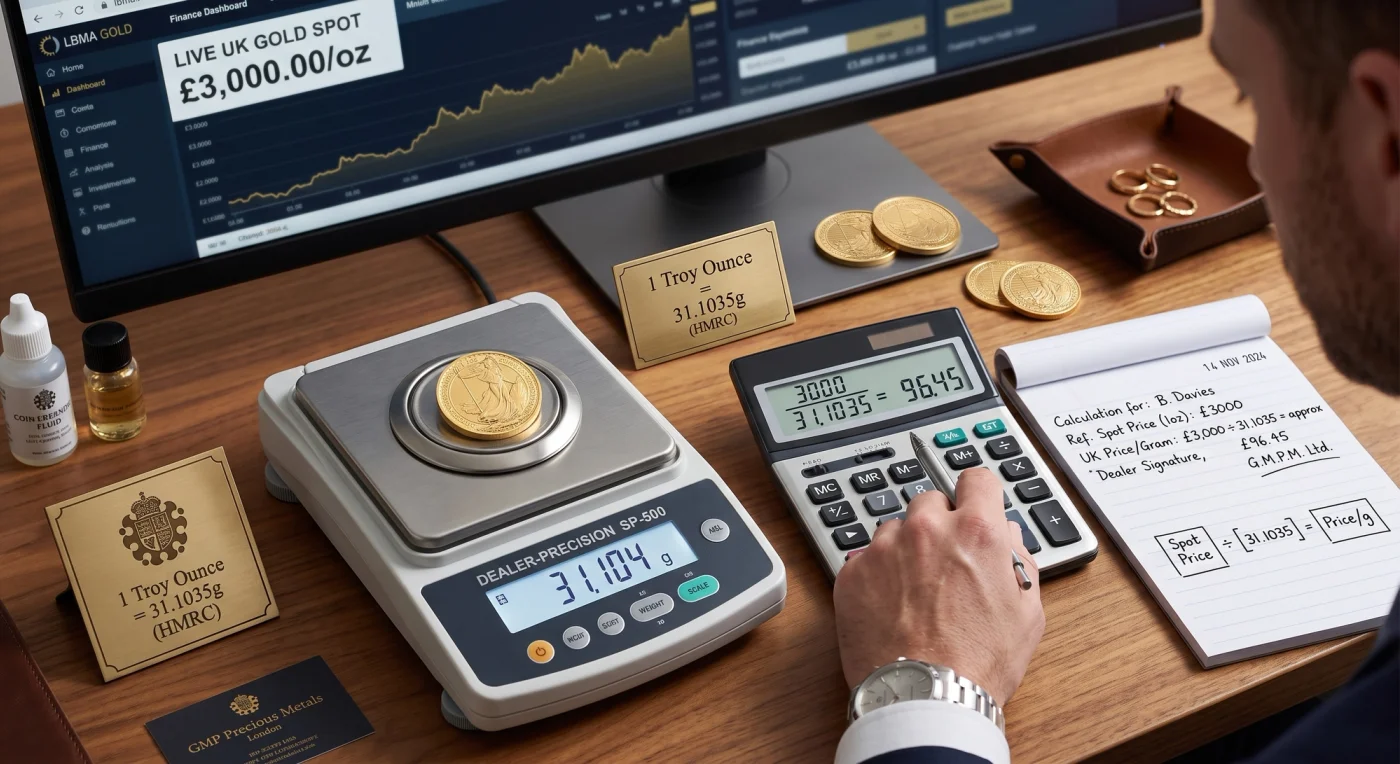
HOW IS THE GOLD PRICE PER GRAM CALCULATED?
The basic calculation is straightforward:
Gold price per gram = gold price per troy ounce ÷ 31.1035
If you already have a price per gram, you can calculate the value of a quantity of fine gold by multiplying the two figures:
Fine-gold weight × gold price per gram = estimated metal value
For example, if one gram of fine gold were valued at £100:
1g of fine gold = £100
5g of fine gold = £500
10g of fine gold = £1,000
These figures represent a simplified metal-value calculation. They do not necessarily represent the price of a finished gold product or a dealer's offer when buying gold from you. We recommend calculating fine-gold content first and then applying a current reference price to estimate the gross metal value.
GOLD PRICE PER GRAM VS FINE-GOLD CONTENT
The amount of gold in an item is not always the same as its total weight.
Gross weight is the weight of the entire item. Fineness indicates how much of that weight is gold. The fine-gold content combines the two.
For example, 10g of 18-carat gold is not 10g of pure gold. Eighteen-carat gold has a fineness of 750, meaning 750 parts per thousand are gold.
The calculation is:
10g × 0.750 = 7.5g of fine gold
- Gold purity
- 9-carat
- Fineness
- 375
- Fine gold in 10g
- 3.75g
- Gold purity
- 14-carat
- Fineness
- 585
- Fine gold in 10g
- 5.85g
- Gold purity
- 18-carat
- Fineness
- 750
- Fine gold in 10g
- 7.50g
- Gold purity
- 22-carat
- Fineness
- 916.7
- Fine gold in 10g
- 9.17g
- Gold purity
- 24-carat
- Fineness
- 999+
- Fine gold in 10g
- Approximately 10g
| Gold purity | Fineness | Fine gold in 10g |
|---|---|---|
| 9-carat | 375 | 3.75g |
| 14-carat | 585 | 5.85g |
| 18-carat | 750 | 7.50g |
| 22-carat | 916.7 | 9.17g |
| 24-carat | 999+ | Approximately 10g |
This is why the gold price per gram should not automatically be multiplied by the gross weight of jewellery or another gold item. You first need to establish how much fine gold it contains.
IS THE GOLD PRICE PER GRAM THE SAME AS THE PRICE OF A GOLD BAR?
Not necessarily. For example, if a 10g gold bar contains 10g of fine gold. Its underlying metal value can be estimated by multiplying those 10g by the current gold price per gram in the UK. However, the bar itself can have a retail premium. The final price may then be higher than its calculated metal value.
At Bullion House, we recommend comparing gold products using fine-gold content and the full price, rather than focusing on the headline price or the gross weight.
HOW TO CALCULATE THE VALUE OF GOLD JEWELLERY
The gold price per gram can also help estimate the metal value of jewellery, but jewellery requires an extra step because it may contain alloys and non-gold components.
For example, if you have a 10g item marked as 18-carat gold:
10g × 0.750 = 7.5g fine gold
If the reference gold price were £100 per gram:
7.5g × £100 = £750 estimated metal value
The actual amount a buyer offers may differ. Jewellery can have value based on its workmanship, brand, design, age, condition and gemstones, while a scrap buyer may focus primarily on recoverable precious metal.
Non-gold components such as stones, clasps, springs and other materials can also add to an item's gross weight without adding to its fine-gold content.
WHY DOES THE GOLD PRICE PER GRAM CHANGE?
The gold price is not fixed. It moves with the wider gold market.
For UK buyers, the price in pounds can also be affected by movements in the sterling exchange rate because international gold prices are commonly quoted in US dollars. UK investors therefore need to consider both movements in the underlying gold price and changes in the GBP/USD exchange rate.
GOLD PRICE PER GRAM WHEN SELLING GOLD
If you're selling gold, the current gold price per gram in the UK can provide a starting point for estimating its metal value. First identify the gold, then establish its weight and fineness. Convert this into fine-gold weight and multiply it by an appropriate current reference price.
Remember that a buyer's quote can account for testing, refining, insurance, staff, market movement, stock risk, demand and the dealer's margin. The most useful figure when comparing buyers is therefore the net amount you will receive, after any applicable deductions.
GOLD PRICE PER GRAM WHEN BUYING GOLD
When buying physical gold, use the gold price per gram as a reference point, rather than using it as the final price. A useful comparison involves:
- The current reference gold price
- The product’s fine-gold content
- The premium
- The total price you will pay
- Delivery, payment or storage costs
- The potential resale price.
This gives you a much clearer picture than comparing two products by their advertised price alone.
Frequently asked questions
WHAT IS THE GOLD PRICE PER GRAM IN THE UK?
The gold price per gram is the current market reference value for one gram of fine gold. It can be calculated by dividing the gold price per troy ounce by 31.1035.
HOW MANY GRAMS ARE IN A TROY OUNCE OF GOLD?
One troy ounce contains 31.1035 grams. This is the standard conversion used for precious metals and is also specified by HMRC.
HOW DO I CALCULATE THE VALUE OF MY GOLD?
First, establish the item's gold-bearing weight and fineness. Calculate its fine-gold content, then multiply that amount by a current gold price per gram to estimate its metal value.
IS THE GOLD PRICE PER GRAM THE SAME AS THE PRICE I PAY?
No. A physical gold product can include a premium above the underlying metal value. Product size, manufacturing, distribution and dealer costs can all contribute to the final price.
IS THE GOLD PRICE PER GRAM THE SAME AS WHAT I RECEIVE WHEN SELLING GOLD?
Not necessarily. A dealer's buyback quote can take account of testing, refining, market movement, demand and other costs. Compare the final net amount offered rather than assuming you will receive the full reference price.
HOW DO I CALCULATE THE VALUE OF 18-CARAT GOLD?
Multiply the gold-bearing weight by 0.750 to estimate the fine-gold weight. For example, 10g of 18-carat gold contains approximately 7.5g of fine gold.
IS GOLD VAT-FREE IN THE UK?
Qualifying investment gold is exempt from VAT. HMRC sets specific criteria for bars, wafers and coins, so not every gold item automatically qualifies.
DOES THE GOLD PRICE PER GRAM CHANGE?
Yes. Gold prices move with market conditions, while the sterling price can also be affected by movements in the exchange rate. A live price should therefore be checked whenever you are making a purchase or sale.
Sources and further reading
Rules and market terms can change. Check the dated sources below and take advice on tax, regulation or personal finances where your position calls for it. For the practical side of buying or selling physical gold, speak to the Bullion House team.